Skip to content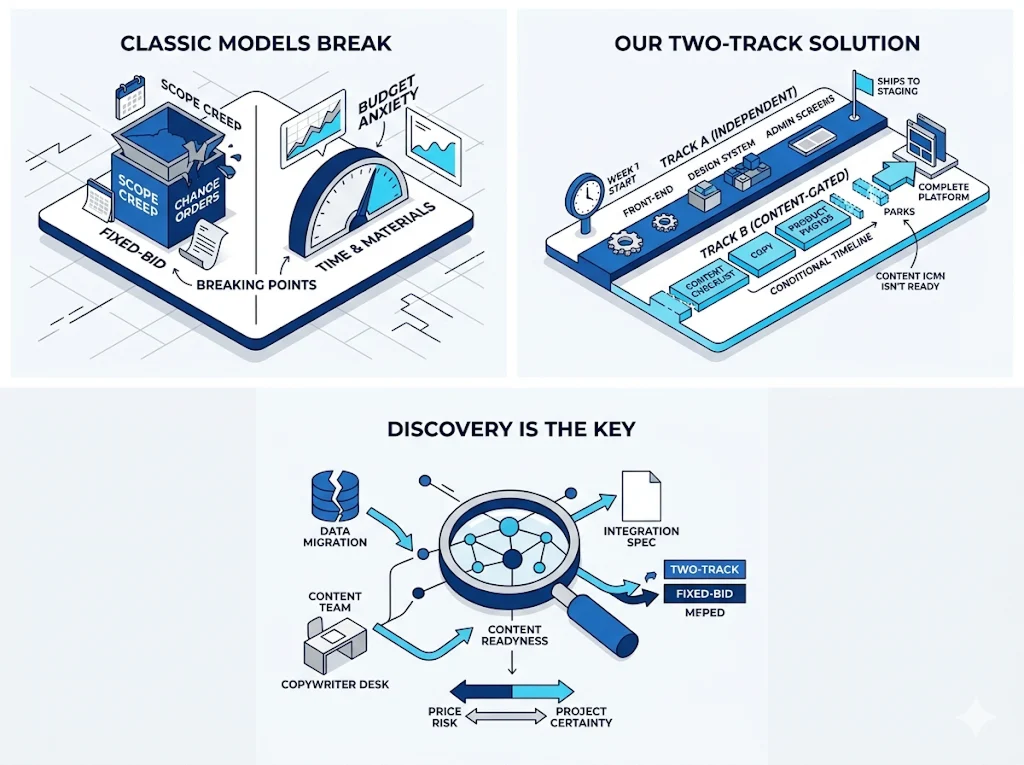
The two pricing defaults, and where they break
Most agency proposals default to fixed-bid or time-and-materials. Both are reasonable on paper. Both fail in different ways under contact with real B2B scope.
Fixed-bid: the certainty that’s a fiction
Fixed-bid says: here’s the price, here’s the scope, here’s the delivery date. The buyer signs a contract that looks like procurement of any physical asset. The problem is that software scope is rarely fixed at the moment of signature.
What actually happens: requirements shift mid-project because a stakeholder who didn’t attend the discovery call now wants two features changed. Or the client’s content team is six weeks behind on copy and product photos for the very pages the agency is supposed to ship. Or the integration spec the buyer’s IT team promised at week 2 lands at week 7, in a different format than agreed.
In a fixed-bid model, every change becomes a change order. Change orders carry friction — internal approval, legal review, additional invoices. Agencies that price tight in the bid have two options when change orders pile up: absorb the cost and erode margin to zero, or push back hard and damage the relationship. Neither outcome is what the buyer wanted when they chose certainty.
Time and materials: the open meter
T&M says: we’ll bill what we work, here’s our rate, here’s an estimate. The agency is incentivised correctly — to work efficiently and bill honestly — and the buyer keeps flexibility on scope.
The problem is that “flexibility” maps onto procurement systems that need a number. CFOs don’t approve open-ended spend. Boards don’t approve “around $80,000 ± 30 percent.” Buyers who choose T&M frequently end up with budget anxiety from month two onward, regardless of how well the project is going. The status update becomes a defensive exercise instead of a planning one.
T&M also assumes both sides trust each other enough to question rate-of-burn without it turning into a contract dispute. That trust takes months to build. In the first 90 days of a new agency relationship, neither side has it.

The hidden variable both models ignore
The reason both default models fail isn’t price structure. It’s that they treat content and data readiness as an external problem — the client’s problem to solve before development can start.
In practice, content readiness is the single biggest predictor of whether a software project ships on time. We’ve seen this across three verticals in the last 18 months: a Canadian mortgage CRM, a Saudi fintech LOS, and a tennis facility admin system. The technical work in each was scoped within a 15 percent variance. The schedule variance was 0 to 11 weeks, driven entirely by how ready the content, data migration, or integration specs were when development was supposed to start.
Three places content readiness shows up as a hidden cost:
- CRM and database migrations. The client says “we’ll export the data from the old system.” Six weeks later, the export turns out to be three CSVs with duplicate keys, missing fields, and a fourth file no one mentioned. Mapping logic that was scoped at 3 days takes 3 weeks.
- Content-gated landing pages. The product or service page can’t go live without 12 paragraphs of copy and 4 product photos. The marketing team that promised them is short-staffed. Development sits in QA for two weeks waiting on copy that arrives in a sequence no one can predict.
- Regulated-industry integrations. Banking, healthcare, KSA government — the integration spec needs to be signed off by a third party that doesn’t share your sprint cadence. The dependency lives outside the team’s control.
A pricing model that assumes content and data are ready is a pricing model that breaks every time content and data are not ready. Which is most of the time.
The two-track structure we now use
Our current proposal format separates a software project into two parallel tracks, plus an optional integration phase. The split is based on one rule: can this work be done independently of client-supplied content and external data, or does it depend on them?
Track A: independent scope
Everything that doesn’t require client content or third-party data to begin. Front-end architecture, design system, core navigation, account and authentication flows, internal admin screens, deployment pipeline, performance baseline. Track A starts at week 1, runs on a fixed scope and fixed timeline, and ships into a staging environment.
Track A pricing is fixed-bid because the variables are inside the agency’s control. The buyer gets a deliverable they can review and react to within 4–8 weeks, regardless of where their content team is.
Track B: content-gated scope
Everything that requires client-supplied content, copy, photography, product data, or stakeholder sign-off on copy direction. Product landing pages, blog templates, CMS configuration with real content loaded, customer-facing flows that include marketing copy.
Track B pricing is also fixed for the scope, but the timeline is conditional on a content-readiness checklist signed off at kickoff. If content slips, Track B parks. Track A continues independently. The buyer always has a moving deliverable to look at, even when their content team is behind.
Phase 2: integrations after data is real
Anything that touches external systems — CRM, ERP, payment gateways, government APIs, third-party data feeds — sits in Phase 2 and is quoted separately once the integration spec is in hand. We don’t price integration work blind. The risk-adjusted cost is always higher than the optimistic estimate, and absorbing that risk into a fixed bid penalises buyers whose integrations turn out to be clean.
Example from a recent KSA proposal:
For an education sector client, we priced the same project three ways: Track A at $17,500 (independent scope, no content dependency), Track B at $20,500 (content-gated, conditional timeline), and Phase 2 integrations at approximately $11,000 to be confirmed after the third-party API documentation was provided. Total ceiling around $49,000, but the buyer could approve Track A alone and start in week 1, with Track B and Phase 2 as separate go/no-go decisions at their own pace. The proposal was 12 pages instead of 4, but the procurement team accepted it the same week.
When the two-track model breaks
This isn’t a universal answer. Three scenarios where two-track adds friction instead of removing it:
1. Projects under $15,000 total budget. The overhead of writing two tracks, two timelines, and two acceptance criteria is disproportionate to the scope. Use a single fixed-bid with a clear list of what’s out of scope.
2. Pure rebuilds with frozen content. If the client is migrating an existing product with no copy changes, no new pages, and a defined data model, content readiness is not the variable. Fixed-bid is honest.
3. R&D and prototyping. When the goal is to learn whether something works, not to ship a defined product, T&M with a weekly burn cap is the only honest model. Pretending you can fixed-bid an unknown is how agencies lose money and clients lose trust.
The two-track model works best for scoped builds — products that have a target, a defined end state, and a buyer whose content team operates on a different cadence than the development team. Which is most B2B software projects.
How we use discovery to identify the right model
The choice between fixed-bid, T&M, and two-track happens during discovery, not in the proposal. Discovery is where you find out whether the client’s data is ready, whether the integrations are documented, and whether the content team is staffed.
Three questions we ask before pricing:
- Can the buyer hand over a content-readiness checklist with 80 percent of fields filled in? If yes, content gating is low-risk and Track B can be aggressive. If no, content gating drives the timeline and the two-track structure is mandatory.
- Is the integration spec for any external system already written, or does it still need to be agreed with a third party? If it’s written, integrate-and-bid. If not, Phase 2.
- What’s the longest acceptable gap between buyer milestones? If the buyer needs to see progress every 2 weeks, Track A is the answer regardless of where Track B sits. If the buyer is comfortable with monthly check-ins, a single-track fixed-bid may still work.
The honest reason discovery matters is that it’s the only place where you can find the answer before you’ve committed to a price. After signature, every discovery question becomes a renegotiation.